Short answer: yes, LinkedIn is one of the sources AI answer engines reach for on business questions. But almost every piece of advice being sold on the back of that finding rests on a far weaker evidence base than anyone admits. At Digital Hype we read the six primary studies everyone quotes, mapped where they contradict each other, and checked the technical layer none of them examined. The one finding that holds up is also the most useful: engagement on LinkedIn and citation in an AI answer run on two separate engines, and sometimes those engines pull in opposite directions.
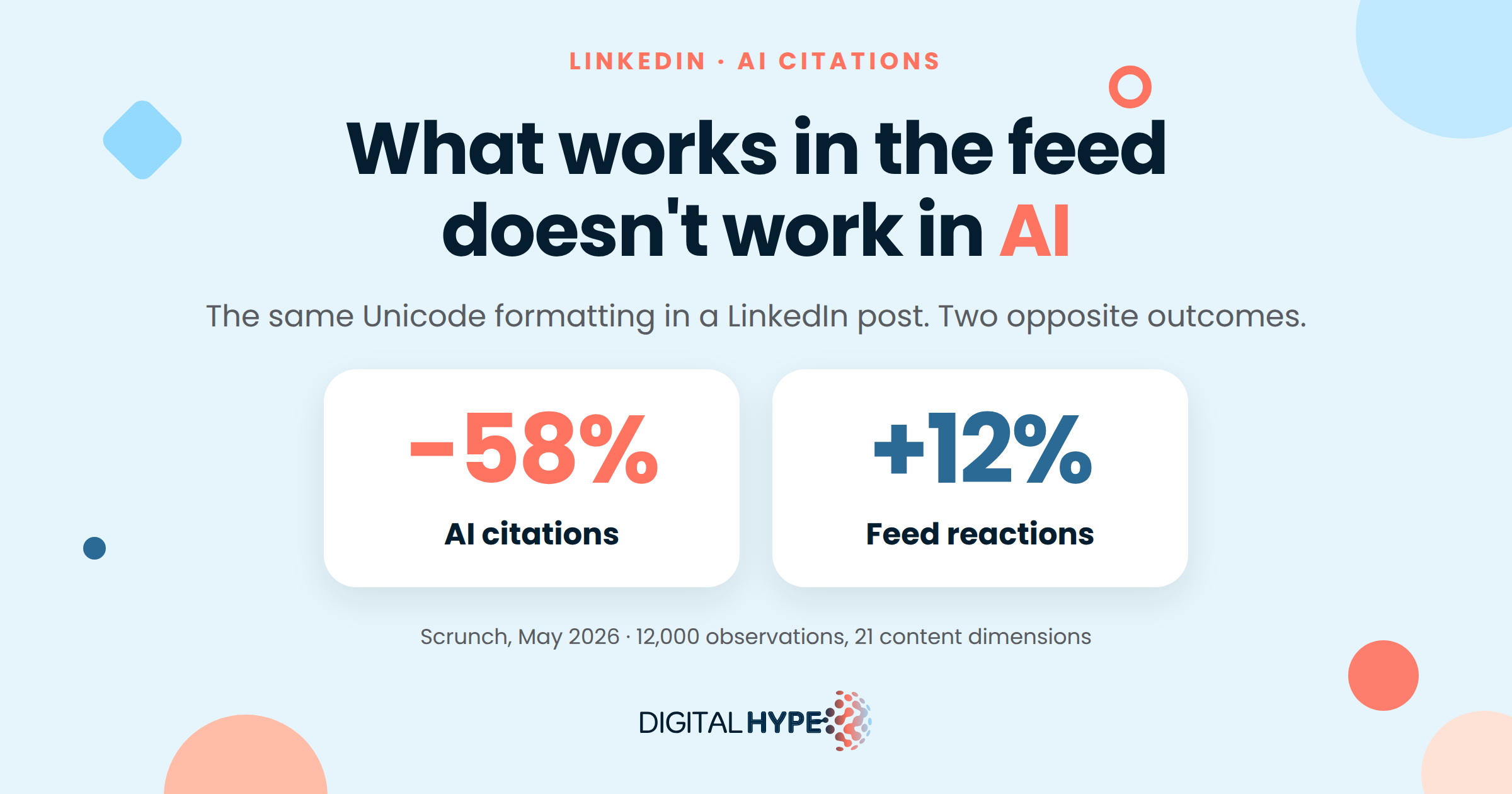
-58% citations, +12% reactions
The exact same action in a LinkedIn post, two opposite outcomes. This is the finding that explains why these two scoreboards cannot be read on the same scale.
Why this is a commercial question, not a technical curiosity
Your B2B buyer has largely made up their mind before they speak to you. According to 6sense’s Buyer Experience Report (November 2025, roughly 4,000 buyers across North America, EMEA and APAC), 94% of buying groups ranked their preferred vendors before making first contact with any vendor, and bought from that preliminary choice 77% of the time. 95% of purchases went to a vendor that was on the day one shortlist. The point of first contact moved from 69% to 61% of the journey, which means buyers reach you later, after their view has already formed.
And a growing share of that view forms inside an engine that cites sources. A G2 survey from March 2026 (1,076 B2B software buyers) found that 51% now start their research with an AI chatbot more often than with Google, up from 29% in April 2025. 69% chose a different vendor than they had planned based on what the chatbot told them, and 33% bought from a vendor they had never heard of before.
Balance matters here. Forrester reported in January 2026 that 94% of business buyers use AI somewhere in their buying process. A Gartner survey from the same window (n=646, fielded August to September 2025) found that only 45% reported deliberate generative AI use to gather information on vendors and products. The gap is a definitional one rather than a contradiction: Forrester measures any AI contact, Gartner measures self-reported intentional use. Both numbers are real, and anyone quoting only the 94% is telling half the story.
What the whole market is quoting right now
The line in every agency deck in 2026 is “LinkedIn is the second most cited domain in AI answers.” Six primary studies sit behind it. Here is what they actually found:
- Semrush (10 March 2026, 325,000 prompts, 89,000 unique LinkedIn URLs, January to February 2026): LinkedIn appears in 14.3% of ChatGPT Search responses, 13.5% of Google AI Mode responses, and 5.3% of Perplexity responses. Average 11%. Second behind Reddit.
- Otterly.ai (3 June 2026, 1,310,455 citations across 161,440 URLs, January to June 2026): Pulse articles account for 72.2% of citations, feed posts 26.1%, profiles 1.7%.
- Meltwater (12 May 2026, 9.5 million citations across six engines including Claude): LinkedIn ranks second behind YouTube, and accounts for 0.53% of all citations.
- Profound (9 March 2026, 1.4 million citations): LinkedIn ranks first for professional queries. Profile citations collapsed from 33.9% to 14.5% in three months.
- Peec AI (March 2026, 30 million sources, via Search Engine Land): the ranking is Reddit, YouTube, then LinkedIn.
- Ahrefs (June 2025, 76.7 million AI Overviews): LinkedIn does not appear in the top ten at all.
Read together, the honest formulation is this: LinkedIn is a top three cited domain in professional and B2B query sets, and roughly first when the query set is restricted to professional queries. It is not a leading domain for general queries, and its rise is a phenomenon of the past year. Rank language also badly oversells absolute presence. The same LinkedIn that is “number two” is also 0.53% of all citations by Meltwater’s count.
The finding that holds: engagement and citation are two separate engines
This is the heart of it, and the part almost nobody discusses. The only study built with genuine controls comes from Scrunch (6 May 2026): 12,000 observations of LinkedIn posts in ChatGPT between 15 January and 15 April 2026, with every post annotated across 21 content dimensions so the effect of each dimension could be measured separately on citation and on reactions.
The results:
- Technical detail: plus 77% likelihood of citation, roughly zero effect on reactions.
- Named entities (companies, tools, products): plus 33% citation, plus 5% reactions.
- Topic specificity: plus 18% citation, plus 13% reactions.
- Unicode formatting (fake bold characters, decorative glyphs): minus 58% citation, plus 12% reactions.
- Link in the first comment instead of in the post body: minus 31% citation, plus 11% reactions.
In their words, a post’s reaction count has near zero predictive power for citation in ChatGPT once content dimensions are controlled for.
Those last two bolded lines are the whole point. The two most common tactics in B2B LinkedIn management, Unicode formatting to stop the scroll and link in comments to avoid the algorithm’s link penalty, buy engagement at the direct cost of citation eligibility. That is not a theoretical caveat. It is an inverted priority: the same action that improves one scoreboard damages the other.
The finding converges with two independent sources. Otterly found near zero Pearson correlations between engagement and citation: likes at minus 0.06, comments at minus 0.04, emoji and hashtags at minus 0.02 each. Meltwater found that among the most cited content, 100% used bulleted or numbered lists, 92% used subheadings, 75% named specific entities, and 67% contained quantitative data. Three studies, three methodologies, one direction.
The mechanism: how LinkedIn content reaches an AI engine at all
None of the studies published a properly evidenced causal account. Otterly asserts one in two sentences. So we checked LinkedIn’s robots.txt ourselves (31 August 2026, 120,190 bytes, 4,862 lines, 77 declared user agent groups). The structure is unambiguous, and it explains a great deal.
LinkedIn fully blocks every crawler that gathers data for model training and every crawler that fetches a page live: GPTBot, ChatGPT-User, ClaudeBot, Claude-User, PerplexityBot, Perplexity-User, Google-Extended, CCBot and others. It also blocks anything not explicitly named, via a blanket default rule.
At the same time it permits precisely the search index crawlers: Googlebot, Bingbot, OAI-SearchBot and Claude-SearchBot. Per OpenAI’s own documentation, GPTBot gathers content for training, while OAI-SearchBot is used to surface websites in ChatGPT’s search features, and a site that blocks it will not be shown in ChatGPT search answers.
Put differently, LinkedIn made a deliberate and surgical choice: index me so you can cite me, do not train on me, and do not fetch me live. That is why LinkedIn is simultaneously famous for hostility to scraping and one of the most cited sources in AI answers. Those are not contradictory facts. They are the same policy.
Where the mechanism meets the data
Otterly found something odd in its own dataset and did not explain it: the feed updates category contains just 136 URLs, 0.1% of the sample, against 93,593 post URLs. These are the same posts.
The explanation sits in robots.txt. Every LinkedIn post has two addresses. The one beginning /feed/update/ is explicitly disallowed to Googlebot and Bingbot, and an anonymous request to it returns a sign up wall. The one beginning /posts/ is open, and serves the full post to anyone. The URL form that is blocked in the file is exactly the URL form that is missing from the citation data. As far as we can determine, nobody has published that connection.
Index me so you can cite me. Do not train on me. Do not fetch me live.
From this follows a conclusion more useful than any format tip: LinkedIn’s visibility in AI engines is downstream of classical search indexing, not of any direct relationship with the AI companies. The sharpest proof is Perplexity. Both of its crawlers are fully blocked in the file, and it still cites LinkedIn at volume. It is not reaching LinkedIn by crawling. It is pulling LinkedIn URLs out of a third party search index.
Two practical notes that bear directly on day to day work, and that most guides get wrong. First, a company page can publish articles. LinkedIn’s official help page, updated in late August 2026, states plainly that all members and page admins can publish articles, and that a page admin sees an option to choose whether to publish as themselves or as the page. Most third party guides claim the opposite. Second, the first line of a post is effectively its URL, as LinkedIn itself notes, which makes that line function as a title tag.
One thing that does not help: schema markup
Worth stating plainly, because a lot of AEO advice is built on it: adding structured data does not appear to buy AI citations. Ahrefs ran the test (11 May 2026) on 1,885 pages that added JSON-LD schema, matched against control pages, comparing the 30 days before and after. The result: Google AI Overviews minus 4.6%, Google AI Mode plus 2.4%, ChatGPT plus 2.2%. In their words, no platform showed a meaningful citation increase after schema was added. A separate searchVIU experiment found that five AI systems did not read schema at all when fetching pages in real time, extracting only the visible HTML.
The caveats matter and Ahrefs states them: every tested page already had 100+ AI Overview citations before schema was added, so the study cannot say whether schema helps a page that is not yet visible at all. The window was 30 days, all schema types were pooled, and pages often changed other things at the same time.
Our reading: keep your structured data, because it still earns rich results in classic search and costs nothing to maintain. Just do not expect it to move AI citations, and do not let it displace the thing that does appear to move them, which is specific, structured, entity-dense writing.
Company page or personal profile? It depends on the question being asked
Four studies give four different answers, because they measured four different things. Otterly found named individual authors receiving 91.7% of citations against 8.3% for company pages. Semrush found 59% individual members on ChatGPT and Google AI Mode, but 59% company pages on Perplexity. Meltwater found 75% individual profiles against 25% company pages.
Otterly’s figure is less impressive than it looks. A Pulse article always carries a named individual author, so “named individuals get 91.7%” is largely a restatement of “Pulse articles get 72.2%.” It is not independent evidence that AI engines prefer humans over brands.
The one study that asked the right question is Radyant’s (May to July 2026, nine accounts, limitations stated openly). It split results by query intent and found that company pages account for 68% of LinkedIn citations on branded prompts and only 2% on non branded prompts.
The practical implication is clear: your company page is a perception asset, not a discovery asset. It works well when someone already asks the engine about you by name, and is close to irrelevant when someone asks “who is the best agency for X”. This is why Digital Hype separates those two objectives when building a client’s LinkedIn plan, rather than measuring both against the same scoreboard. The operational side of that sits in our LinkedIn page management service.
What this research does not prove
This is the chapter no agency deck includes, and it is the most important one for anyone about to move budget based on the numbers above.
Not one of these studies has a control group
Otterly says so itself, and none of the sites quoting it pass the caveat along: the dataset includes only already cited URLs, and the results explain repeated citation behaviour rather than initial eligibility. Every study starts from the winners and nobody looks at the losers. There is no denominator, and no matched sample of content that was never cited. That knocks out a whole run of advice that sounds well founded:
- “Pulse articles get cited more than posts” is a correct description of citation volume within already cited content. It is not evidence that publishing an article raises your odds of being cited.
- “1,021 words is the optimal length” means nothing without knowing the median length of articles that were never cited. If that is also around 1,000 words, length predicts nothing.
- “Frequent posters make up 75% of cited authors” is an exposure effect. People who publish more have more URLs eligible for citation.
Two major studies contradict each other on the central question
Otterly: articles 72.2% of citations, posts 26.1%. Meltwater, on a sample seven times larger: posts 72%, articles 12%. Profound sits closer to Meltwater. Two studies pointing almost exactly opposite ways, and neither addresses the other. The claim that Pulse articles dominate citations rests on a single study. We lean toward giving Pulse articles weight because of the technical mechanism described above, but that is our judgment, not a research consensus.
Every study comes from a vendor selling the solution
Six primary studies, six vendors of AI visibility monitoring tools. None peer reviewed, none with released raw data, and no independent replication of any finding. We searched specifically for published methodological critiques of Otterly or Semrush and found none, while at least six secondary sites passed the numbers along without interrogating any of them.
A citation is not traffic, and it is certainly not pipeline
The most uncomfortable data in the field comes from Omniscient Digital (May 2026). At one SaaS client, AI visibility rose from 11.5% to 12.1% while AI referral traffic fell 64%. At a second client, visibility rose from 13.1% to 21.4% while AI attributed conversions fell roughly 90%. On top of that, GA4 may capture as little as 9% of true AI referred mobile traffic because of referrer stripping in embedded browsers. The measurement is broken in both directions at once. Otterly itself disclaims any traffic or business impact claim.
These numbers go stale quickly
Profound measured profile citations collapsing from 33.9% to 14.5% in three months. Semrush’s figures are from January and February 2026. Scrunch flags algorithm changes in April. Every number in this article is accurate as of its date and not necessarily today, which is why we have dated each source rather than presenting them as current facts.
The blind spot: none of this covers non English queries
Here it is worth being direct: there is no data. Not one of these studies breaks citations down by language, and not one states which language or market it was run in, so even the assumption that they are English language work is an inference from the absence of a stated scope.
For any company selling into more than one language market, that is a material gap rather than a footnote. The evidence that does exist points to language mattering a great deal. Temso AI (April 2026, seven million citations across 350,000 responses in 12 countries) found that when a query is asked in a local language, AI engines cite sources in that same language between 51.7% and 85.4% of the time depending on the engine. Their sample covered Spanish, Dutch, German, Swedish, Italian and French. Hebrew was not included, and neither was any other smaller language. Weglot’s study (10 August 2026, 1.3 million citations across Google AI Overviews and ChatGPT) points the same way inside a single language pair: untranslated Spanish sites received 431% more citations for Spanish queries than for English ones in AI Overviews, while ChatGPT showed near parity. Two studies, two methods, one direction: the language of the query shapes which sources surface, and it shapes it differently on different engines.
The reasonable inference, and we label it as an inference rather than a finding, is that thinner language corpora mean a smaller competitive set per query, and therefore a lower bar to being cited. In a matched pair of retrieval tests on Israeli media, 22 of 24 Hebrew outlets surfaced against only 12 of 24 English ones. But the same mechanism cuts the other way: where local language content on a topic is too thin, the engine may fall back to English sources rather than surface a weak local one. The opportunity and the invisibility risk are the same mechanism pointing in two directions.
The practical consequence for an Israeli company selling abroad, or any company operating across languages, is that visibility in one language tells you nothing about visibility in another. They are two separate programmes. Digital Hype builds answer engine optimization work on that assumption, and measures actual presence rather than relying on the inference.
What to do with this if you run B2B LinkedIn
Five practical conclusions that follow from what is actually supported, rather than from what sounds good:
- Stop using Unicode formatting and link in comments as your default. Both buy engagement at the price of citation eligibility. If AI visibility is a goal, that is a bad trade. Company pages get a bonus here: per Metricool, a company page that puts the link in the post body sees 51% more impressions and 41% more interactions, while the trend runs the other way for personal profiles.
- Write specific, not polished. Technical detail, named tools and companies, numbers with a source. These carry the largest positive effects, and they are also the hardest thing for a competitor to copy.
- Measure the company page on the right question. It is a perception asset for people already looking for you, not a discovery engine. Expecting it to produce leads from buyers who have never heard of you is measuring it against a job it was not built for.
- Make sure your content sits on an indexable URL. It sounds technical, and it is the single most practical point in this article: excellent content on a blocked address does not exist as far as the engine is concerned.
- Do not throw out engagement metrics. They still measure something real, just not this. Digital Hype runs both scoreboards in parallel for B2B clients and does not convert one into the other, as part of our ongoing social media management.
Summary
LinkedIn genuinely entered AI answers over the past year, and that is a real shift worth accounting for. But the evidence base behind the common advice is thin: no study has a control group, the two largest studies contradict each other on the central question, and all of them were published by companies selling the solution. What does hold, across three independent sources, is that engagement and citation are measured on two separate and sometimes opposed engines, and that AI visibility is downstream of classical search indexing. That is the right starting point for a B2B LinkedIn plan in 2026, rather than a list of tips derived from a correlation with no denominator.
Want to know how your company shows up in ChatGPT today?
Digital Hype, marketing that combines AI with human strategy.
Frequently asked questions
Does ChatGPT really cite content from LinkedIn?
Yes. According to Semrush’s January to February 2026 study of 325,000 prompts, LinkedIn appears in 14.3% of ChatGPT Search responses, 13.5% of Google AI Mode responses and 5.3% of Perplexity responses. That said, Meltwater found it accounts for only 0.53% of all citations across all query types, so its presence is concentrated in professional and business questions.
Should we publish LinkedIn Pulse articles to appear in AI answers?
The studies disagree. Otterly found articles account for 72.2% of LinkedIn citations, while Meltwater, on a sample seven times larger, found the reverse: posts at 72% and articles at 12%. What is clear on the technical side is that articles sit on a permanent, indexable URL that is readable without logging in, which is why Digital Hype tends to recommend them for content meant to be cited over time.
Does a LinkedIn company page help with AI visibility?
Mainly for queries that include your company name. Radyant’s summer 2026 study found company pages account for 68% of LinkedIn citations on branded prompts and just 2% on non branded prompts. The company page is a perception asset for people already searching for you, not a discovery tool for new buyers.
Do likes and comments affect the chance of being cited by AI?
No. Scrunch, which analysed 12,000 observations while controlling for 21 content dimensions, found reaction count has near zero predictive power for citation. More than that: Unicode formatting lowers citation likelihood by 58% while raising reactions by 12%, and putting the link in the first comment lowers citations by 31% while raising reactions by 11%.
How does LinkedIn content reach AI engines if LinkedIn blocks scraping?
LinkedIn’s robots.txt blocks every training crawler and every live fetch crawler, but explicitly permits the search index crawlers: Googlebot, Bingbot, OAI-SearchBot and Claude-SearchBot. This means LinkedIn’s AI visibility depends on classical search indexing rather than on any direct relationship with the AI companies.
Does schema markup help get content cited by AI?
The evidence says no. Ahrefs tested 1,885 pages that added JSON-LD schema against matched controls in May 2026 and found Google AI Overviews down 4.6%, AI Mode up 2.4% and ChatGPT up 2.2%, none of which is a meaningful increase. Keep schema for classic search rich results, but do not expect it to move AI citations.
Is there any data on AI citations for non English content?
No. No study breaks LinkedIn citations down by language, and none states its own language scope. The indirect evidence is that AI engines cite sources in the query’s own language between 51.7% and 85.4% of the time across the six languages that have been tested, and that thinner corpora mean less competition per query. That is a reasonable hypothesis, not a measured finding.