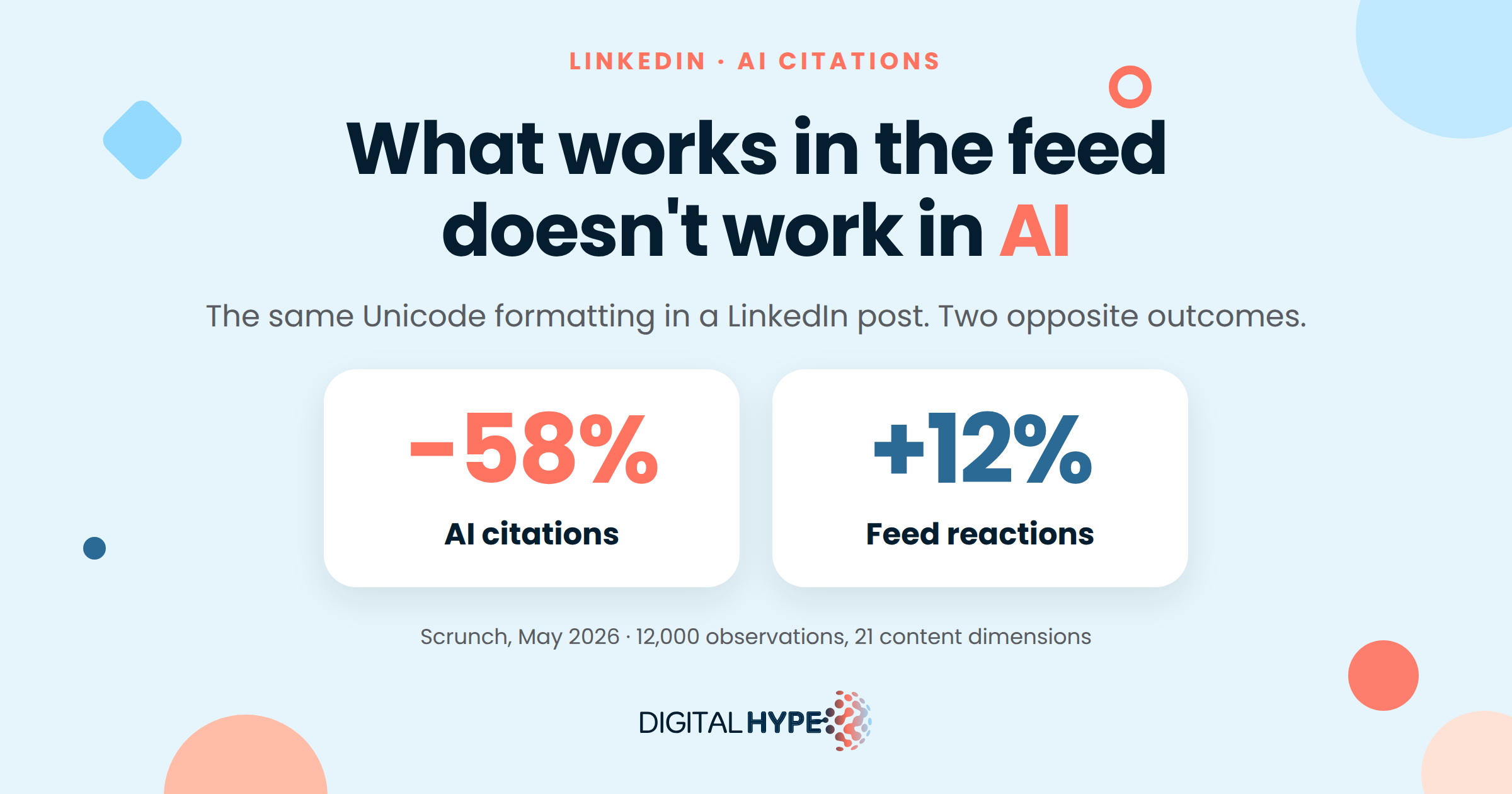

If your LinkedIn company page feels quieter than it used to, you are not imagining it. Company pages now compete for a shrinking sliver of the feed against a rebuilt, AI-driven ranking system, a follower-invite limit that LinkedIn cut by 80% in March 2026, and personal profiles that consistently out-perform brand pages. For B2B companies in Israel selling into global markets, the algorithm shift is not a minor annoyance. It changes which format to post, how often, and who inside the company should be posting at all. This guide breaks down what actually changed in 2026, what the data says works now, and how to rebuild reach without guessing.
63%
Personal LinkedIn profiles get, on average, 63% higher engagement than company pages, based on a Metricool sample of 673,658 posts. Only 7% of company pages grew enough in a year to move up a follower tier. A company page alone has a structural ceiling – it is not a failure of your content.
What actually changed in LinkedIn’s algorithm in 2026
LinkedIn rebuilt its feed ranking around a large language model system, widely reported as “360Brew,” that evaluates member profiles, engagement history and professional signals instead of simple keyword or hashtag matching (LinkedIn Engineering Blog, “Engineering the next generation of LinkedIn’s Feed,” corroborated by PPC Land’s coverage of the rebuild). In practice, that means generic, promotional posts get filtered out earlier, while posts that trigger real reading time, saves and meaningful comments get pushed further into other people’s feeds.
The follower-invite cut that quietly reset company page growth
In March 2026, LinkedIn cut the monthly follower-invite credit for company pages from 250 to 50, and removed the “select all” button that let admins mass-invite their network (reported by The Scott Partnership and The X Concept). Fifty invitations a month is a scarce resource. Sent broadly, it does nothing. Sent to a hand-picked list of marketing and C-level contacts at relevant B2B companies, a 20-30% acceptance rate still adds a meaningful trickle of the right followers every month – and every additional page admin multiplies the available quota.
Which post formats actually get reach now
Two large independent datasets agree on the ranking of formats, even if the exact multipliers differ. A sample of 305,842 company page posts from AuthoredUp found document or PDF carousels reach 1.40x the platform median, single images 1.21x, polls 1.19x, and text-only posts just 0.42x – the weakest format a company page can publish. A separate sample of 1.3 million posts from 16,645 business pages, from Socialinsider, found average impressions in the 1,000-5,000 follower range break down as documents 525, multi-image posts 490, video 355, polls 340, single images 315, plain text 300 and link posts 235.
Socialinsider’s 2026 organic benchmark report puts native document posts at 7.00% engagement (up 14% year over year), against a 5.20% platform average, with multi-image at 6.45%, video at 6.00%, single image at 5.30%, text at 4.50%, polls at 4.20% and link posts trailing at 3.25%. The pattern is consistent across both datasets: the format that keeps someone reading inside the feed – a document, a carousel, a genuinely useful image – outperforms the format that sends them away from LinkedIn with a link.
How often to post, and why frequency stopped being a risk
A common fear among B2B marketers is that posting more often “dilutes” reach. The data says the opposite. Buffer’s analysis of more than 2 million posts from 94,000 accounts found that moving from one post a week to two-to-five posts a week added an average of 1,182 impressions per post, not spread thinner across more posts. LinkedIn’s own guidance for company pages recommends the same range: two to five posts per week. Separately, Contentin’s 2026 roundup, citing Digital Applied’s analysis, found pages that post weekly grow followers 5.6x faster than pages that post monthly, and roughly half of a post’s total lifetime impressions land within the first 48 hours.
“More than 40% of B2B deals stall because of internal misalignment within the buying group” – Edelman-LinkedIn, 2025 B2B Thought Leadership Impact Report. Consistent company page content is one of the few channels that reaches every stakeholder in that buying group at once.
Why the Israeli B2B market needs a deliberate LinkedIn strategy
Israel has roughly 3.10 million LinkedIn members, or 47.8% of the adult population, according to DataReportal’s “Digital 2026: Israel” report – one of the highest LinkedIn penetration rates globally for a country this size. For a country built on B2B technology exports, that concentration matters: the buyers, investors and partners an Israeli company is trying to reach are disproportionately likely to be active on LinkedIn rather than other channels. At Digital Hype, we manage LinkedIn company pages for Israeli B2B and healthcare-technology clients specifically because the algorithm rewards consistency and format discipline that most in-house teams do not have the bandwidth to sustain week after week. Our LinkedIn company page management service is built around exactly the data in this article: format mix, posting cadence, and a deliberate follower-invite strategy rather than a mass-invite approach that no longer works.
We also use AI as part of how we work, not as a replacement for judgment. We use AI tools to analyze which of a client’s past posts performed best by format and topic, and to draft first passes of document carousels faster – but every post a Digital Hype client publishes is reviewed and shaped by a strategist who knows the account, the industry and the buyer. That combination of speed and human judgment is what makes it possible to hold a two-to-five-post weekly cadence without the quality dropping.
- Lead with documents and carousels: the highest-performing format across every dataset we reviewed.
- Post two to five times a week: more frequency adds reach per post, it does not dilute it.
- Spend your 50 monthly invites deliberately: target marketing and C-level contacts at relevant companies, not a broad blast.
- Add page admins: the 50-invite quota is calculated per admin, so each additional admin multiplies your monthly capacity.
- Encourage employee posting: personal profiles still substantially outperform company pages, so a founder or team member sharing the same message extends its reach.
Frequently asked questions
How often should a B2B company post on LinkedIn in 2026?
Two to five times a week, which is both LinkedIn’s own recommendation for company pages and the range Buffer’s analysis of 2 million posts found added reach per post rather than diluting it.
Why has LinkedIn company page reach dropped in 2026?
LinkedIn rebuilt its feed ranking around a large language model system that weighs engagement quality and professional relevance more heavily, and company pages structurally receive a smaller share of feed real estate than personal profiles, which several independent analyses put well below personal-profile reach.
Do personal profiles really outperform company pages on LinkedIn?
Yes. A Metricool sample of 673,658 posts found personal profiles get 63% higher average engagement than company pages, which is why employee advocacy – team members sharing company content from their own profiles – remains one of the highest-leverage tactics available.
What LinkedIn post format gets the most reach in 2026?
Documents and PDF carousels, consistently, across independent datasets from both AuthoredUp and Socialinsider. Text-only posts are the weakest format a company page can publish.
How did LinkedIn’s follower-invite limit change in March 2026?
LinkedIn cut the monthly follower-invite credit for company pages from 250 to 50 and removed the “select all” bulk-invite option, making a targeted, deliberate invite strategy far more valuable than a broad one.
How many LinkedIn users are there in Israel?
Approximately 3.10 million, or 47.8% of the adult population, according to DataReportal’s “Digital 2026: Israel” report – one of the highest LinkedIn penetration rates of any country, which makes the platform disproportionately important for Israeli B2B companies.
Want a LinkedIn page that actually grows?
Digital Hype manages LinkedIn company pages for Israeli B2B and healthcare-technology brands, combining AI-assisted analysis with human strategy and writing.